AREX Express vs All-Stop: Which Train from Incheon Airport?
In this guide
Prices and timetables checked on 4 October 2026 on the official Airport Railroad (AREX) website. Fares and schedules change, so confirm the details for your travel date.
Two kinds of train leave Incheon Airport for Seoul on the same tracks, and they are sold in completely different ways. One runs non-stop to Seoul Station and needs a ticket before you board. The other stops at every station along the line and works with an ordinary transit card. Which one suits you depends less on speed than on where you are sleeping on your first night.
On station signs and in Korean apps you will see them as 직통열차 (Express) and 일반열차 (All-Stop, literally the regular train). The Korea Tourism Organization’s English transport guide uses the same names, the Express Train and the All-Stop Train.
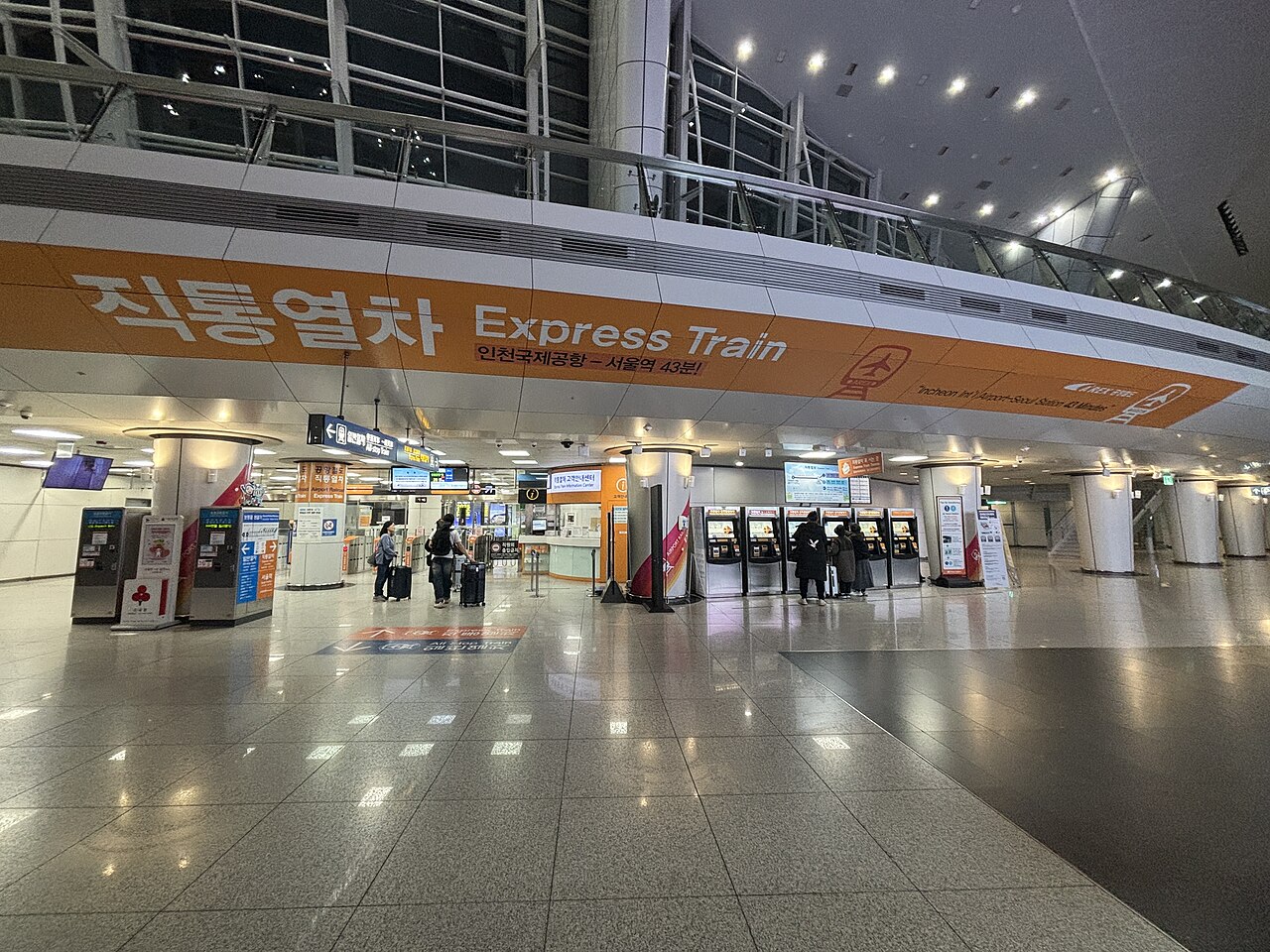
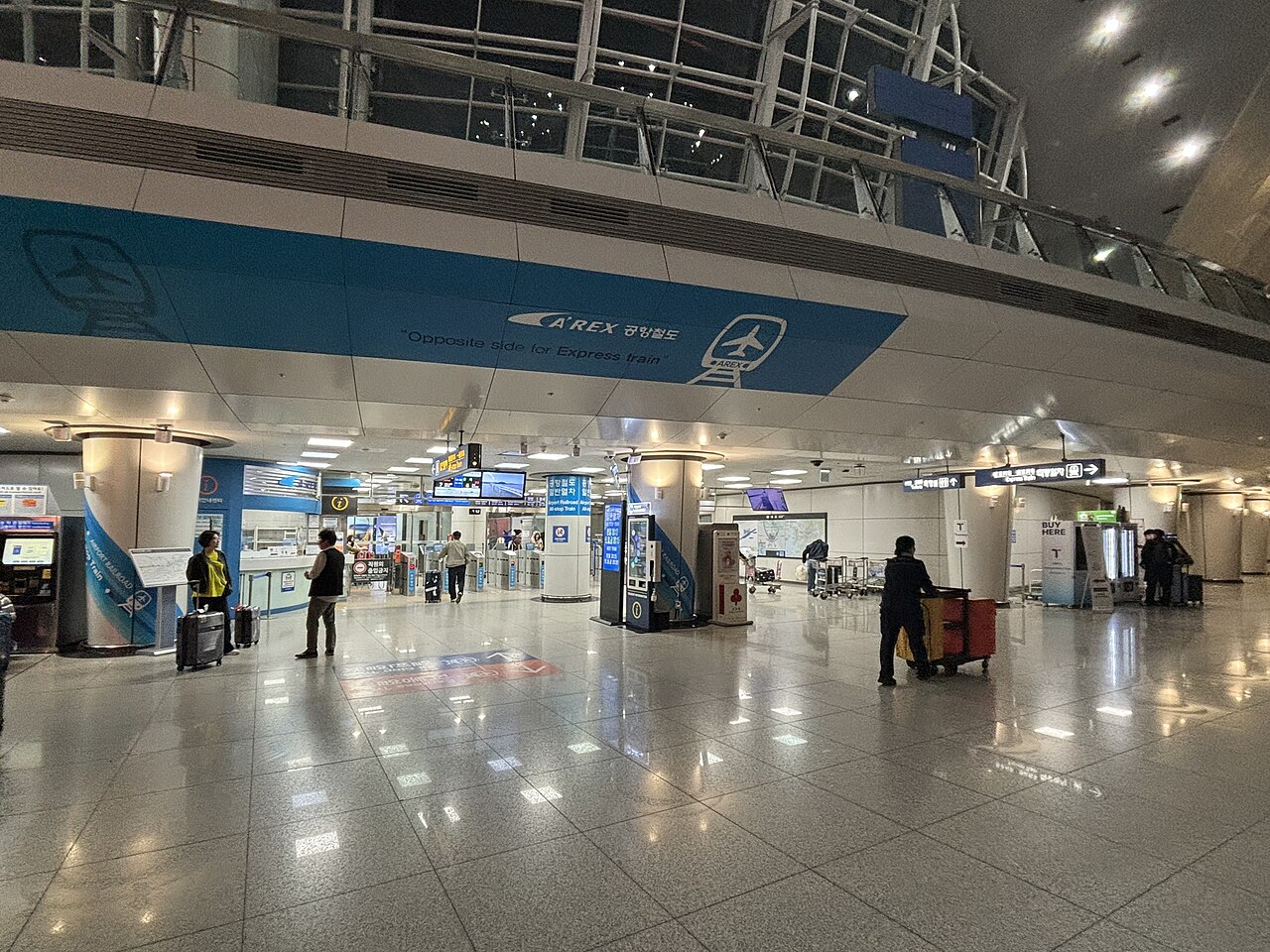
The two trains side by side
| Express | All-Stop | |
|---|---|---|
| Route | Seoul Station, Terminal 1, Terminal 2, with no stops in between | 14 stations from Seoul Station to Terminal 2 |
| Travel time | 43 minutes to Terminal 1, 51 minutes to Terminal 2 | 59 minutes to Terminal 1, 66 minutes to Terminal 2 (some trains take 2 to 6 minutes longer) |
| Adult fare | 13,000 won listed (normal fare 18,500 won to T1, 19,100 won to T2) | 4,750 won to T1, 5,350 won to T2 from Seoul Station |
| Ticket | Separate ticket before boarding | Transit card or single-journey card |
The express fare is shown on the AREX site as an adult fare of 13,000 won, with the normal fares of 18,500 won (Seoul Station to Terminal 1) and 19,100 won (to Terminal 2) printed beside it. The page does not say how long the 13,000 won price applies, so treat it as the price listed on 4 October 2026 and check the current fare when you buy. Children aged 6 to under 13 pay 9,500 won. The official page also lists discounts for seniors aged 65 and over who are Korean nationals, disabled passengers and national merit holders, and says discounts cannot be combined.
On travel time, the official figures put the All-Stop 16 minutes behind the Express to Terminal 1 (59 minutes against 43) and 15 minutes behind to Terminal 2 (66 against 51). Some All-Stop trains take 2 to 6 minutes longer than those figures, according to the AREX page.
How often the Express runs
The weekday timetable lists 26 departures in each direction. From Seoul Station the first Express leaves at 06:00 and the last at 23:00. From the airport, the first leaves Terminal 2 at 05:16 and the last at 22:40, with each train reaching Terminal 1 about eight minutes later. By our count from the official table, the gap between departures ranges from 34 to 55 minutes at Seoul Station and from 25 to 65 minutes at the airport, averaging a little over 40 minutes in both directions.
That matters if your flight lands just after a train has left. A 65-minute wait is possible at the airport on weekdays, and a missed train does not mean you lose the day, because the All-Stop keeps running. Holiday timetables are published separately, and we did not check them here.
What the All-Stop fare table shows
All-Stop fares depend on distance, and the official table lists a price for every pair of stations for passengers paying with a transit card. A few examples show how much the fare changes along the line:
- Seoul Station to Hongik University: 1,550 won
- Seoul Station to Gimpo Airport: 1,750 won
- Hongik University to Terminal 1: 4,650 won
- Gimpo Airport to Terminal 1: 4,350 won
- Seoul Station to Terminal 1: 4,750 won, and to Terminal 2: 5,350 won
A single-journey card costs 100 won more than the transit-card fare and adds a refundable 500 won deposit. Our guide to using the Seoul subway map explains how to buy and return that card. Children under six ride free, with up to three infants per accompanying guardian.
Between Seoul Station and Terminal 1 the All-Stop calls at 11 intermediate stations. Several of them are transfer points: Seoul Station connects to KTX and Lines 1 and 4, Gongdeok to Lines 5 and 6, Hongik University to Line 2, Digital Media City to Line 6, Magoknaru to Line 9, and Gimpo Airport to Lines 5 and 9. This is why the All-Stop is often the practical choice when your hotel is not at Seoul Station.
Five arrival situations and the train that fits
You are staying near Seoul Station. The Express is the straightforward option. Its customer service center is on the second basement level of Seoul Station, and the Seoul Station city airport terminal is part of the package when you leave Korea (see below).
You are staying in Hongdae. Hongik University Station is on the All-Stop line, and the fare table lists 4,650 won to Terminal 1. Taking the Express would mean going to Seoul Station first, which can erase its time advantage.
Your hotel is near Gimpo Airport or on Line 9. The All-Stop connects at Magoknaru and Gimpo Airport. The Express does not stop at either.
You arrive with a lot of luggage. The Express offers reserved seats and a cabin crew service, and the official page says the toilet in car 4 is usable by wheelchair users. Whichever you choose, plan how you will move bags through transfer stations; the subway guide linked above covers exits and elevators.
You land late. The last weekday Express leaves Terminal 2 at 22:40 (22:48 from Terminal 1). Check the All-Stop timetable on the official site for later options; its timetable lists Geomam as a final stop for some All-Stop trains, so confirm that your train continues to the airport.
Practical checks before you board
- Buy the Express ticket before you board. The Express customer service centers are on the first basement level of Terminal 1 and Terminal 2, and on the second basement level of Seoul Station.
- The Express offers free Wi-Fi and, on request, free bottled water, according to the official page.
- AREX’s English video says Express tickets can be bought on its reservation website or the dedicated app and used at the gates as a mobile ticket, and that the Express has a dedicated kids’ compartment.
- For the All-Stop, a rechargeable Tmoney card avoids the single-journey deposit.
- Look at the terminal you are leaving from. Terminal 2 is the stop after Terminal 1 on both trains, which adds the 8 minutes shown in the Express timetable.
AREX’s own video
AREX publishes its promotional film in an English-language version on its official YouTube channel, about four and a half minutes long. YouTube shows automatically generated English captions for it, so expect occasional errors. We have not taken any fares or times from the video; the figures in this guide come from the AREX website pages listed under Sources. A few service details below are attributed to the video’s English narration.
Leaving Korea: the Seoul Station city airport terminal
The Express has a second use on your way home. Passengers who hold an Express ticket can check in, drop off baggage and clear immigration at the terminal on the second basement level of Seoul Station, then travel to the airport without carrying bags. The service is meant for international departures, it is limited to Express ticket holders, and the official airport page lists check-in from 05:20 to 19:00. For Terminal 1 departures, check-in closes three hours before the flight. Airlines take part individually, so confirm that yours does before relying on it. AREX’s video adds that City Airport Terminal users can use a dedicated departure passage at Incheon to reach the departure hall without queuing, which matches the airport corporation’s description of a dedicated departure corridor on level 3.
Our take
The Express makes sense when your destination is Seoul Station or you are connecting onward by KTX. If your stay is near Hongdae, Gimpo Airport or another station on the line, the All-Stop is usually the simpler and far cheaper route, because you avoid a second journey and pay roughly 4,350 to 5,350 won, depending on the station and terminal, instead of the Express fare. The time saved by the non-stop service is real, but it only counts when the train drops you close to where you are going.
Sources and review
Source check: 4 October 2026. Fares, timetables and service details were taken from the official AREX website. Fares and schedules can change, so confirm them on the official pages before travel.
- AREX: Express train introduction (fares, travel time, services)
- AREX: Express train timetable
- AREX: All-Stop fare guide
- AREX: All-Stop timetable
- AREX: All-Stop train introduction (travel time)
- Korea Tourism Organization: Airport transportation guide
- Incheon International Airport Corporation: Seoul Station city airport terminal
No affiliate links have been added to this guide.
About the author
The editor of Korea Decoded holds Korea’s national Tourist Interpreter Guide qualification in English, spent seven years teaching Korean to international students at university, and has professional experience in broadcasting. Korea Decoded was created to answer the practical and cultural questions international visitors ask—and to help readers understand Korea with greater context and confidence.